Domènech i Montaner and Sant Pau - Modernist Vision Explained
Discover how Domènech i Montaner designed Hospital de Sant Pau as a revolutionary blend of architecture, hygiene, and social progress.
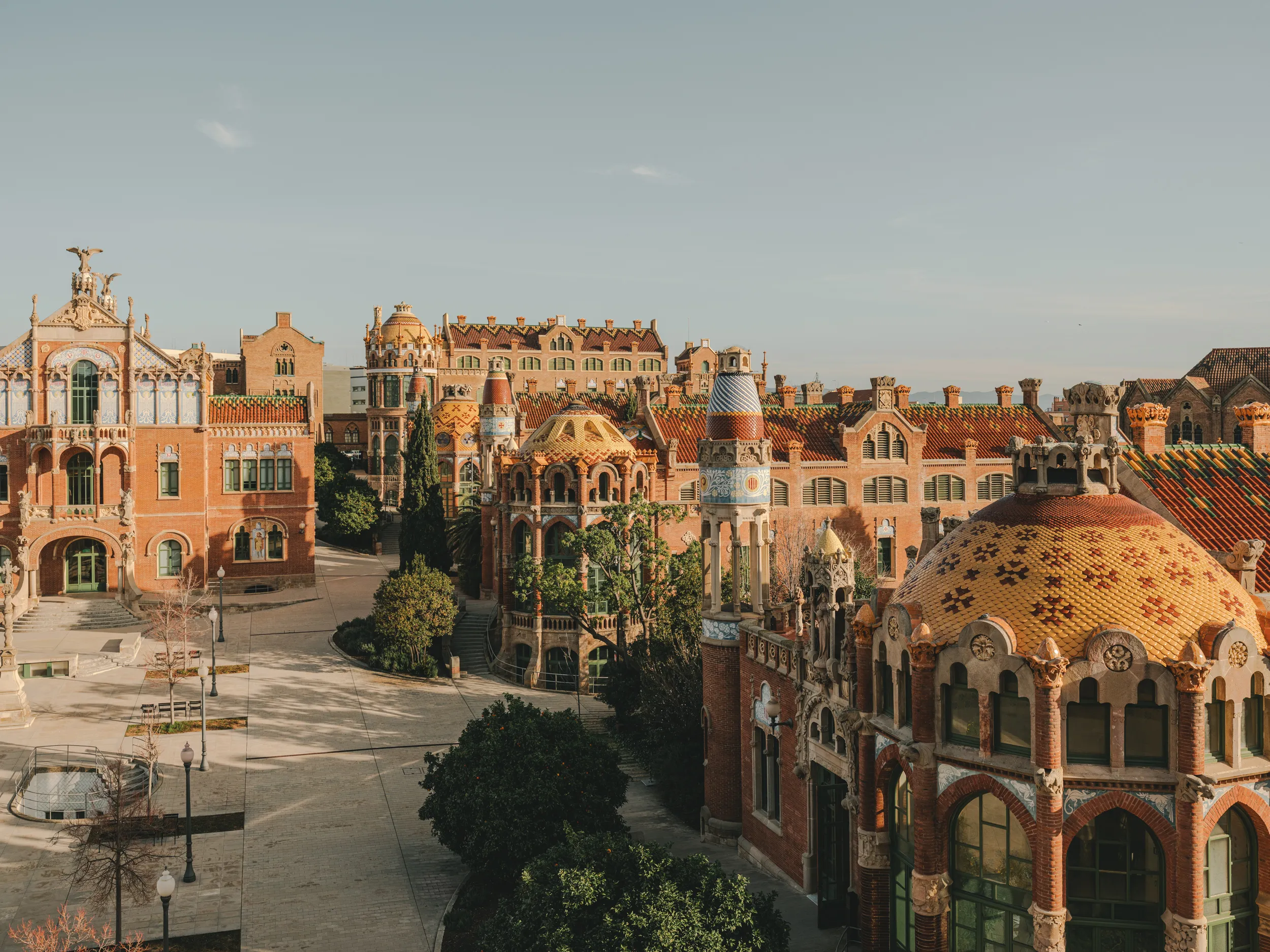
There are architects who design façades, and architects who design ways of living. At Sant Pau, Domènech i Montaner does the second.
A city disguised as a hospital
Instead of one monumental block, he imagined a constellation of pavilions connected underground. The logic was radical for its time:
- sunlight over gloom
- air circulation over stagnation
- gardens over confinement
Timeline in four beats
| Year | Turning point |
|---|---|
| Medieval era | Origins in the old Hospital de la Santa Creu |
| Early 20th c. | New Sant Pau project begins |
| 1929 | Official inauguration phase |
| 1997 | UNESCO recognition (with Palau de la Música) |
Good architecture here is not decorative excess; it is a public-health argument.
Reading the style like a language
- Brick gives warmth and civic identity.
- Ceramics create weatherproof beauty.
- Mosaic introduces iconography and narrative.
- Ironwork provides structure and lyric movement.
Field notes for your visit
- Compare two pavilion façades: same grammar, different accents.
- Look up at rooflines before entering interiors.
- In tunnels, imagine logistics without spectacle.
Final frame
Sant Pau proves Modernisme was never only about beauty; it was also about better systems for ordinary people.
About the Author

Barcelona Modernisme Editor
This guide is written for travelers who want to understand Sant Pau beyond a checklist visit: how to read the architecture, where to slow down, and why this complex remains one of Barcelona’s most emotionally resonant cultural landmarks.
Tags
Comments (0)
Loading comments...